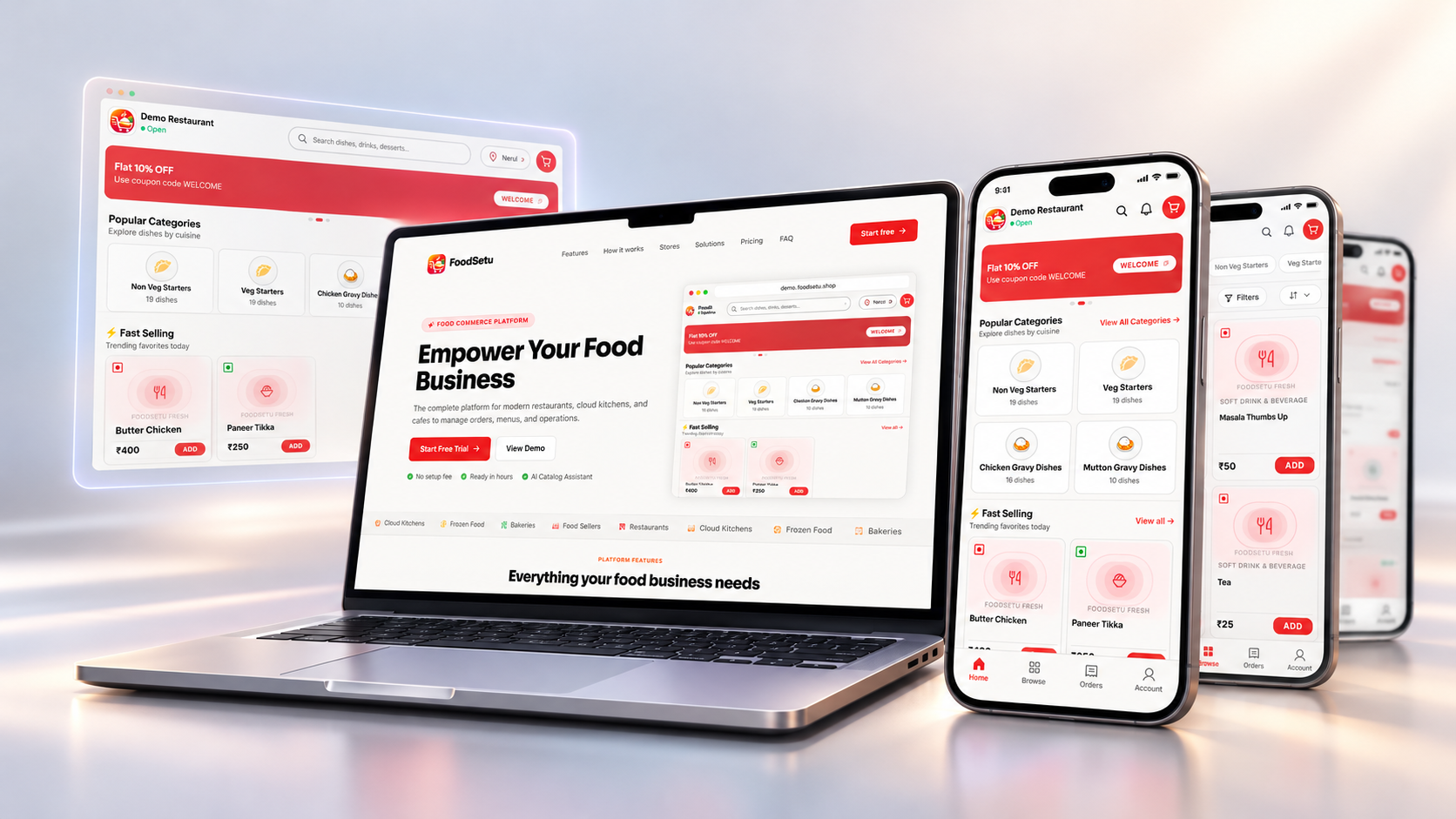
Overview
FoodSetu is an actively developed food commerce platform engineered specifically for independent restaurants, home chefs, and local food sellers. By leveraging Progressive Web App (PWA) capabilities, FoodSetu provides a native-app-like ordering experience directly through browser URLs without requiring diners to download heavy native app packages or sellers to sacrifice high commission cuts.
Problem & Approach
Independent food sellers and neighborhood restaurants face steep aggregator commissions (25% to 35%), restrictive platform control, and high customer friction when trying to launch independent branded applications.
Architecting a multi-tenant platform with a mobile-first PWA storefront. The frontend focuses on instant load times, smooth thumb-zone navigation, and lightweight cart management, backed by relational data schemas in PostgreSQL.
System Architecture
- Frontend / Storefront
- Next.js App Router, React, TypeScript, and Tailwind CSS configured for PWA installation.
- API & Backend
- Modular REST API endpoints handling menu data, tenant profiles, and order payloads.
- Database
- PostgreSQL relational schemas with foreign key relationships for tenants, items, categories, and orders.
Features & Deliverables
- 01Mobile-First PWA StorefrontImplemented
Installable directly to home screens with instant app-like launching, zero app store friction, and responsive touch layouts.
- 02Multi-Tenant Menu & Catalog ArchitectureImplemented
Tenant-specific catalog support allowing restaurants to manage categories, item pricing, dietary tags, and dish availability.
- 03Client-Side Cart & Checkout FlowImplemented
Fast in-memory shopping cart with item quantity adjustments, pricing calculation, and delivery option selection.
- 04Tenant Administration & Store SettingsImplemented
Merchant interface for updating menu items, pricing, and operating status.
- 05Tenant Routing & Slug ResolutionIn Development
Dynamic URL routing (/store/[tenant-slug]) ensuring each restaurant possesses an isolated digital presence.
- 06Role-Based Access Control (RBAC)In Development
Differentiated permissions separating platform administration from tenant store owners.
- 07Automated Order NotificationsPlanned
Direct webhook and messaging notifications for kitchen order alerts.
- 08Offline Menu Browsing & SyncPlanned
Service worker caching to allow offline menu browsing with queued order actions upon reconnection.
Technical Challenges
ProblemEnsuring near-instant page loads on low-bandwidth mobile connections without layout shift.
Resolution:Engineered responsive menu cards with fixed aspect ratios and optimized SVG iconography, minimizing client payload and prioritizing critical render paths.
ProblemArchitecting clean tenant data separation without creating monolithic database bottlenecks.
Resolution:Designed tenant-isolated query filters with relational schema indexing, ensuring each restaurant's requests only touch relevant catalog records.
Contributions & Takeaways
My Contributions
- Designed and built the mobile-first storefront UI with responsive touch controls and cart drawer.
- Configured PWA manifest, service worker lifecycle, and install prompt behaviors.
- Engineered the relational database schema in PostgreSQL for multi-tenant catalog management.
- Implemented REST API endpoints for catalog queries and cart persistence.
Key Learnings
- PWAs significantly reduce customer drop-off compared to requiring native app downloads for simple ordering.
- Multi-tenant state requires strict boundary validation at both the route level and the database query layer.
- Complete tenant custom domain mapping.
- Integrate secure payment gateway checkout flows.
- Implement live kitchen display system (KDS) order status polling.
Interested in discussing this project or working together?
Get in touch